

You should also have realized by now that good, solid basic techniques and practices, such as religious sanitation, and a few others, can result in good beer and more fun than watching back-to-back Star Wars reruns (well maybe).
And as I’ve written before, there’s really no point in being an all-grain snob. Really none at all. But that doesn’t mean that making an all-grain brew isn’t a fantastic challenge. In my previous post, I discussed the basic theory of all-grain brewing. Today, we tackle the how-to, starting with equipment.
When it comes to equipment, one option is to go full hog. Buy larger brew kettles, get a hot liquor tank, convert a cooler into a mash tun, and buy various other bits and pieces to construct a state-of-the-art all-grain home brewery. John Palmer’s site has a nice setup that you can take a look at here. There’s one problem though. Full hog = full price. Building a three-tiered, 50 liter electric pump brewing wonder-machine might be awesome, but for many homebrewers, it’s just too costly.
Even if you have the money (you lucky bastard), you may not have the space. So if you’ve got a tiny apartment (or bank account), is all-grain brewing out of reach? Not at all. There’s a quick, easy, and cheap way of trying your hand at brewing all-grain beer.
This method of brewing is called brew-in-a-bag or BIAB. It’s an excellent way of getting into all-grain brewing without massive investment. In fact, if you’ve got the equipment I’ve listed in my basics and nice-to-have equipment posts, you’re just about ready to go.
BIAB Basic Equipment
Here’s what you’ll need for BIAB:
The Bag.
The obvious one.
As the name suggests, you’re going to be using a rather large mesh bag. Most homebrew supply stores sell these, and they’re generally made from voile mesh (the kind old folks made inner curtains from) and can carry up to (or more than) 5-6 kgs of grains.
A good way of knowing how big your bag should be is to use your brew kettle. If the kettle can fit inside the bag and leave enough space for the bag to be tied, your bag is spot on. Speaking of kettles..
Bigger Brew Kettle
If you haven’t yet bought a bigger brew kettle (shame on you), you will definitely need one for BIAB.
I recommend a kettle of at least 30 liter capacity. Try for a nice, big stock pot made from either aluminum (cheaper), or stainless steel (bling-ier).
Avoid pots that are very wide and squat. It’ll be difficult to maintain a good rolling boil in those (not to mention finding a bag that will fit).
Small Metal Colander
Viole mesh is a great fabric for BIAB, but it isn’t 100% heat resistant. So to keep the mesh off the bottom of your brew kettle where it can get scorched, I recommend placing a metal colander upside-down in the kettle.
That will keep your bag safe and in one piece for multiple brews.
Binder Clips
Yep, everyday binder clips from the stationary shop. You’ll use these to secure the bag to the sides of the kettle, and in turn, prevent the bag from falling into the kettle, thus making it difficult to retrieve at the end of the mash.
Brew Spoonr Clips
A nice, long handled brew spoon, preferably with holes or slots (also known as a mash paddle), is useful for mixing in your grains and preventing clumps and dough balls from forming.
Digital Thermometer
A probe-like thermometer like the ones used to measure the inside of cooked meats (yum) can also be used successfully.
Nice-to-haves: Grain Mill.
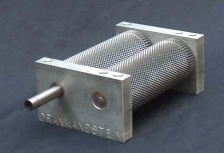 If you’re going to be doing more all-grain brews, the ability to mill your own grain is very convenient.


Great article just one thing never use aluminium pots as far as I know the lead in aluminium taints the brew
A cheap way to crack the grains is to put grains in a zip lock bag and use a rolling pin to crack them
Hi there Anonymous. Modern aluminium is definitely safe to use for brewing. Various health organisations around the world have found that using aluminium cookware does not expose you to as much risk as using things like aluminium foil to wrap food (which in turn is quite benign). I've brewed with aluminium, and know many homebrewers who also do, and have never detected off flavors from aluminium versus stainless. There may be other reasons for preferring stainless (e.g. different heat conductivity), but off-flavors shouldn't be one of them, and nor should health concerns.
Hi Harper,
Thanks for this! Quick question, I've been to about 6 different food equipment shops today trying to find a) A decent brew pot, but can only really find wide and squat ones, and a decent digital thermometers (can find analog ones by the ton).
Any suggestions for around the Joburg area that you can get these?
Hi Grant. Yep–getting the right kettle can be frustrating! I've had the best results with Adams–they are usually happy to order the right sized stock pot for you–it might take a while but the quality is usually quite good.
Digital thermos can be found at the Beer Keg (probe type) or you can get digital meat thermometers from places like @Home. Either will be fine. Hope that helps!
Thanks so much! Just so happens an Adams has just opened like 100m from my office. Guess where I'm going tomorrow?
Thanks again!
Great site by the way!
Thanks for the feedback Grant! Good luck with the brew shopping!